
Is FTE Dead? The Gig Economy
As the rise of AI continues to push the boundaries of business, many workers around the world (particularly in America) are questioning the feasibility of a full-time job. Given the continuous announcements of layoffs hitting the new wire, especially from well-known highly profitable companies, it’s not hard to see why.
It makes intuitive sense: many companies that are investing heavily in AI such as Hyper-scalers like Meta, Amazon and Microsoft are redirecting investment dollars from other sources such as payroll and future hiring. Gone are the days of Americans seeking security via a paycheck and a pension. More workers are figuring out (the hard way) that they need not just other sources of income, but more control on where that income comes from.
A recent Wall Street Journal article (Forget Work. Passive Income Is the New American Dream. - WSJ) details the story of some individuals who are seeking out these other sources. Whether it’s ‘Passive Income’, ‘Side Hustles’ or ‘Gig work’, the desire is the same: have alternative sources of income that do not come from a full time job.
The question becomes: is this feasible and sustainable?
To start, let’s take the temperature of the current job market in the United States.
As of May 2026, the ‘official’ (U3) unemployment rate is 4.3%. This is generally considered a healthy level, or close to what many economists consider ‘Full Employment’, aka the best we can do.
However, when we start to look deeper we can see a different story. The U6 unemployment rate is listed at 8.1% as of May 2026, nearly double the official mark. The difference? The U3 unemployment rate excludes workers that are considered ‘discouraged’ and under-employed, meaning they essentially gave up on finding a new job or are working part time while wanting full-time work. In our opinion, it makes sense to analyze the U6 rate as well since these are still people not working, albeit difficult to track. This means that the official unemployment rate may be relatively low not because people are finding work, but because the counted labor pool is shrinking.
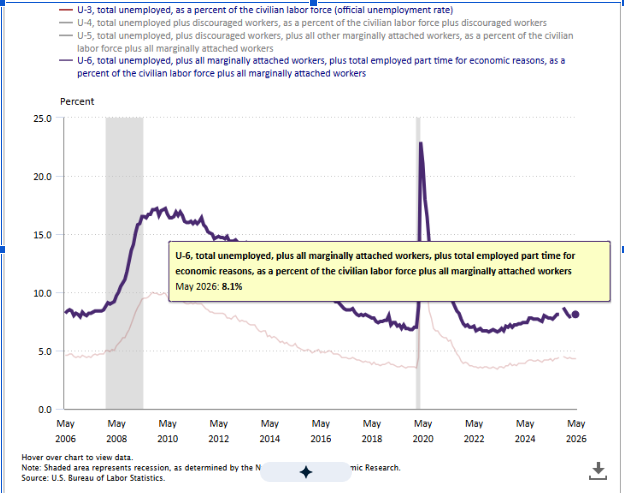
Source: US Bureau of Labor Statistics
This thesis is further validated by the below charts, namely a) steady increase in unemployed persons for longer than 27 weeks since 2022 (when AI became more prevalent), and b) steady decline in the labor force participation rate in that same time period.
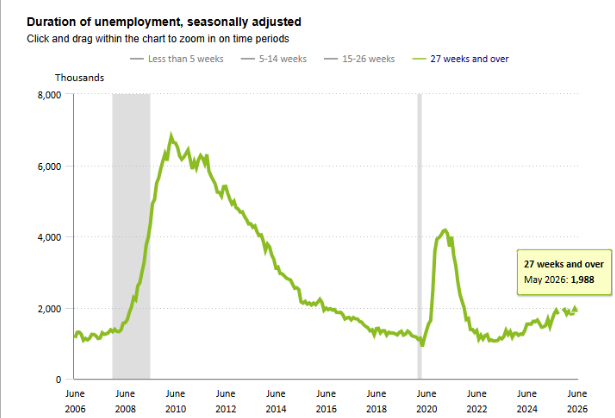
Soucre: US Bureau of Labor Statistics
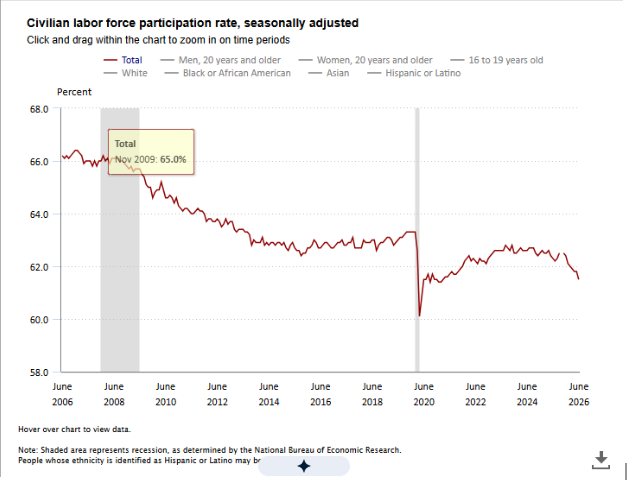
Source: US Bureau of Labor Statistics
While there are other factors at play, such as more baby boomers retiring with less new workers to replace them, this is evidence that the traditional labor pool is shrinking, affecting our view on the labor and jobs market.
Enter the gig economy. People who derive their income in less traditional ways are more difficult to track for the Bureau of Labor Statistics (BLS) but they are certainly part of the working economy. As more skilled workers are becoming discouraged by layoffs and longer hiring processes, the need for other sources of income has increased exponentially.
According to research from Jobbers, nearly HALF of the workforce is doing freelancing or gig work, and it contributes to 5% of the US GDP. This is a significant portion of the economy and likely to continue growing.
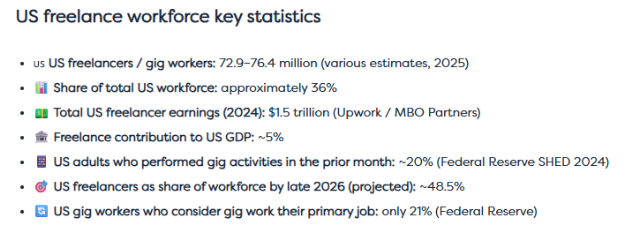
Source: Jobbers.io
While the continued news of layoffs can be stressful for people, the good news is that there are many avenues available for folks to monetize their skillsets to create these additional income streams, even if they’re small to begin with. For example, many traditional newspaper journalists have turned to podcasting and social media to generate additional content (and therefore income) on top of their Full Time Employment (FTE).
As we get further into the age of AI and automation, we’ll likely see an increase in people earning income through freelancing, gig work, passive income or other means, either in addition to or in lieu of FTE. The gig economy is not only sustainable, it’s a necessity to Americans. Entrepreneurship is the future.
Sources used:
Forget Work. Passive Income Is the New American Dream. - WSJ
U.S. Bureau of Labor Statistics : U.S. Bureau of Labor Statistics
Gig economy statistics 2026: the definitive data report - Jobbers