
Short-term Bearish, Long-term Bullish: A Case for Active Management
A common phrase that many investors have heard is ‘time in the market beats timing the market’. Mountains of research suggest that passively investing in a low-cost index fund/ETF will outperform most active management strategies. While this research is accurate, this principle ignores one key ingredient: timing, ironically.
How can this be the case? To start, let’s examine the typical point you’ll hear regarding passive investing. It’ll usually go something like: ‘investing X amount per year over 40 years at a Y% average return will yield $Z at the end.” Here’s a mathematical example:
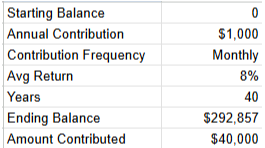
Simply put, putting away $40,000 over 40 years at an 8% return will yield a $243,000 return. Seems great, right? While the math works, the logic can be flawed. The reason? Something known as ‘Sequence of Returns Risk’.
Markets do not return the same amount each year and often vary greatly year over year. Below is a table of the annual price return of the S&P 500 over the last 10 full calendar years:
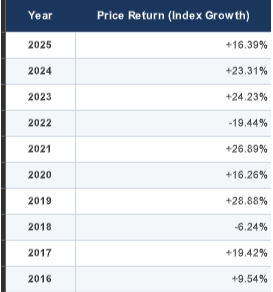
The returns have ultimately been very impressive, but with great variation. This especially affects those who are nearing retirement age. Sequence of returns risk becomes greater as one gets closer to retirement, since the time feature in which compounding over the long term works is diminishing. If one is simply investing passively and retires into or just before a market crash, the impact can be devastating.
For example, below shows the annual S&P 500 return (price) from the period of 2000 through 2011:
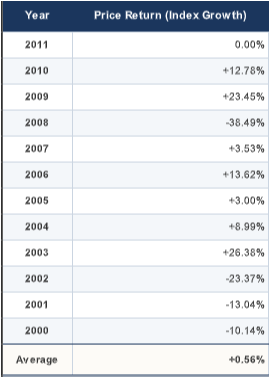
In this timeframe, we saw two significant market crashes (dot-com bubble of 2000 and the financial crisis of 2008). While this is cherry-picking a certain timeframe, we can’t cherry pick our lives. People who were retiring into this era saw a significant impact on their investment portfolios and thus the quality of their retirement.
Traditional financial advice suggests that people should invest more conservatively as they near retirement to offset this risk. Typically this means moving assets from stocks to bonds, which are seen as less volatile and provide an income stream in the form of interest. This is because a bond is a form of debt, in which the company has a legal obligation to repay. By contrast, stocks (or equity) does not obligate the company to any payments or promises to its shareholders.
Below are the returns for the US bond market over the same time period, using ticker BND as a proxy:
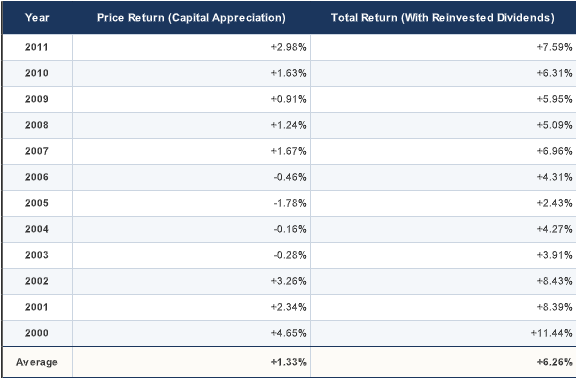
While bonds certainly fared better than stocks in this timeframe, the price returns were still meager. Reinvesting the dividends would have yielded a decent return, but in many cases retirees would likely use the cash flow to help cover expenses instead of reinvesting them, making this argument mute.
To expand this analysis, we ran a study showing the performance of the below portfolios over a 40 year period to determine the effect of timing in retirement:
100% invested in the S&P 500
A typical 60/40 portfolio
A hypothetical ‘target date fund’ in which a portfolio is rebalanced from equities to bonds as a person nears retirement at year 40
The analysis can be found here: Portfolio Returns Data - Google Sheets
The results show, unsurprisingly, that all three portfolio values dropped significantly for those that retired into market crashes, namely in 2000 and 2008. While markets did rebound in the aftermath of both crashes, having an immediately lower balance as you head into retirement undoubtedly affects how that money will be managed going forward. It’s safe to assume that many retirees will look be more conservative with the remaining balance they have and possibly try to withdraw less, which affects the overall quality of their retirement.
However, the less intuitive takeaway is that active management can help mitigate this fear. If a person’s equity and bond positions are properly hedged, or if a portfolio is truly diversified, the ending CAGR may be the same or higher with less volatility. Strategies in which one can employ to accomplish this will be discussed in a future post.
As one nears retirement, active management could become more important to protect the wealth that has been created.